
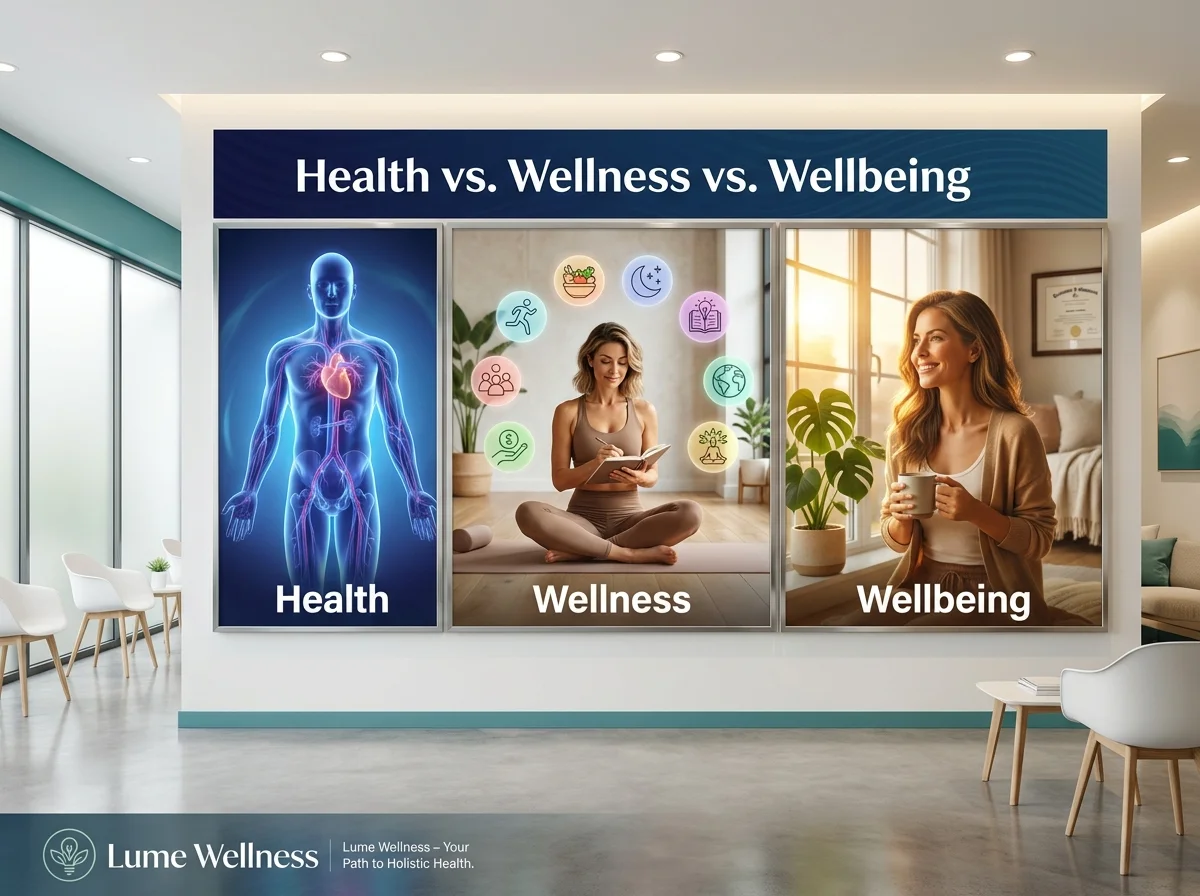
Health is your physical and mental state often defined as the absence of disease. Wellness is the active, ongoing process of making choices that support your best possible life. Wellbeing is the broader feeling of satisfaction, purpose, and quality of life that results from both. You can have good health but low wellbeing. You can have a chronic illness and still have high wellness. They are related but not the same.
These three words get used interchangeably all the time — in doctor’s offices, on fitness apps, in workplace programs. But they actually mean different things. And understanding the distinction isn’t just semantics. It changes how you think about your own body, your choices, and what you’re actually working toward.
Here’s the simplest way to think about it: health is where you are, wellness is what you do, and wellbeing is how your life feels. Let’s break each one down and then show you how they work together.
The Three Terms Defined Simply
| Health The destinatio Your physical and mental state. Are you sick or well? Are your body systems functioning? Health is often measured by labs, diagnostics, and the absence of disease. | Wellness The journey The daily habits, choices, and practices that move you toward better health. Exercise, nutrition, stress management, sleep, learning — wellness is what you do. | Wellbeing The experience How your life feels overall. Your sense of purpose, happiness, connection, and fulfillment. It’s the result of health and wellness working together over time. |
Health: Your Biological Baseline
When most people say “I want to be healthy,” they’re thinking about their body, their weight, their blood pressure, whether they have a disease or don’t. That’s health in the traditional medical sense.
The World Health Organization defines health as “a state of complete physical, mental, and social well-being and not merely the absence of disease or infirmity.” That’s a broad definition but in practice, most healthcare systems focus on the physical and mental dimensions: Are your labs in range? Are your organs functioning? Are you managing your conditions?
Health can be measured. It can change. And critically you can influence it, but you can’t always control it. Genetics, accidents, environment, and age all affect your health in ways no lifestyle habit can fully override.
Wellness: What You Do Every Day
Wellness is not a destination. You don’t “achieve” wellness and then stop. It’s an ongoing, active practice. The daily and weekly choices that either move you toward your best possible health or away from it.
This is the part most people underestimate. Wellness isn’t just going to the gym. It’s multidimensional and most wellness frameworks recognize eight key dimensions that together create a whole, thriving life:
| 🏋️ Physical Exercise, nutrition, sleep, medical care | 🗣️ Emotional Managing feelings, resilience, self-awareness |
| 🧠 Intellectual Lifelong learning, curiosity, creativity | 🤝 Social Relationships, community, connection |
| ✨ Spiritual Purpose, values, meaning, mindfulness | 🌱 Environmental Your surroundings, safety, nature access |
| 💼 Occupational Work satisfaction, balance, career growth | 💰 Financial Financial security, planning, reducing money stress |
Wellbeing: The Feeling of a Life Well-Lived
Wellbeing is the most subjective of the three and also the most meaningful. It’s not just about whether your body functions or whether you make healthy choices. It’s about whether your life feels worth living.
Researchers define wellbeing as a combination of several elements: positive emotions, meaningful engagement in daily activities, positive relationships, a sense of purpose and meaning, and a feeling of accomplishment. These are the things that make you wake up in the morning and feel like your life matters.
Here’s the critical insight: you can be physically healthy and still have low wellbeing. Think about someone who is fit and disease-free but deeply lonely, burnt out at work, and feels no sense of purpose. Their health might be good. Their wellbeing is suffering.
And the reverse is equally true. Someone managing a chronic illness — arthritis, diabetes, or hypothyroidism can have high wellbeing if they’ve built strong relationships, found purpose, and practice wellness habits that support their quality of life every day. Wellbeing is about the whole picture.
How Health, Wellness, and Wellbeing Work Together
These three concepts aren’t separate boxes, they influence each other constantly. Understanding how they interact is the key to actually improving your life, not just checking boxes.
| Health | Wellness | Wellbeing | |
| Nature | A state | A process | A feeling |
| Focus | Body & mind functioning | Daily habits & choices | Quality of life & purpose |
| Approach | Often reactive | Proactive | Holistic, subjective |
| Measured by | Labs, diagnostics, symptoms | Lifestyle habits, dimensions | Life satisfaction, purpose |
| Can you have one without the other? | Yes, healthy but unhappy | Yes, ill but practicing wellness | Yes. Good health, low purpose |
Frequently Asked Questions
What is the difference between health and wellness and wellbeing?
Health is your physical and mental state, whether your body is functioning well and free from disease. Wellness is the active, ongoing process of making choices that support your best possible health across multiple dimensions of life. Wellbeing is the broader feeling of life satisfaction, purpose, and quality of life that results when health and wellness work together.
Can you be healthy but not have good wellbeing?
Yes. Someone can be physically healthy no disease, normal labs but still have low wellbeing if they feel purposeless, lonely, burnt out, or unfulfilled. Health is just one part of wellbeing. The other parts include meaningful relationships, a sense of purpose, positive emotions, and engagement in life.
What are the 8 dimensions of wellness?
The eight recognized dimensions of wellness are: Physical, Emotional, Intellectual, Social, Spiritual, Environmental, Occupational, and Financial wellness. True wellness means nurturing all eight areas, not just physical fitness.