

Most people take GLP-1 medications for at least 12 to 18 months to reach their weight loss goals, and the current medical consensus is that many patients will benefit from staying on treatment indefinitely. That’s because obesity is now classified as a chronic disease by every major medical organization, including the American Gastroenterological Association and the Endocrine Society. Stopping GLP-1 medication typically leads to significant weight regain within the first year, though some patients can successfully taper off under medical supervision once they’ve built sustainable lifestyle habits.
The honest answer isn’t one most people want to hear. But understanding why treatment duration matters, what the clinical data actually shows, and what your options look like at each stage will help you make a much more informed decision about your own care.
What GLP-1 Medications Are and How They Work
GLP-1 receptor agonists mimic a natural gut hormone called glucagon like peptide 1. When you eat, your body releases GLP-1 to signal fullness to the brain, slow down how quickly your stomach empties, and help regulate blood sugar. These medications amplify that process.
The result is a genuine reduction in appetite and food noise (that constant background chatter about what to eat next). You feel satisfied sooner, you think about food less, and your body becomes more efficient at processing glucose and insulin. That’s not willpower. It’s biochemistry.
The most commonly prescribed GLP-1 medications for weight loss include semaglutide (sold as Wegovy for weight management and Ozempic for type 2 diabetes), tirzepatide (sold as Zepbound for weight loss and Mounjaro for diabetes), and the newest option, orforglipron (brand name Foundayo), which was FDA approved in April 2026 as the first oral GLP-1 pill that doesn’t require refrigeration or any food and water restrictions.
Tirzepatide is technically a dual action medication. It targets both GLP-1 and GIP receptors, which is why clinical trials have shown slightly greater weight loss compared to semaglutide alone.
It’s worth noting that GLP-1 medications were originally developed for type 2 diabetes. Their weight loss effects were discovered during those trials, and the dosing and formulations were later adapted specifically for weight management. That’s why you’ll see some of these drugs sold under two brand names: one for diabetes (Ozempic, Mounjaro) and one for weight loss (Wegovy, Zepbound). The active ingredient is the same, but the approved doses and indications differ.
How Long Before You See Results
This is usually the first question people ask, and the answer depends on what you mean by “results.”
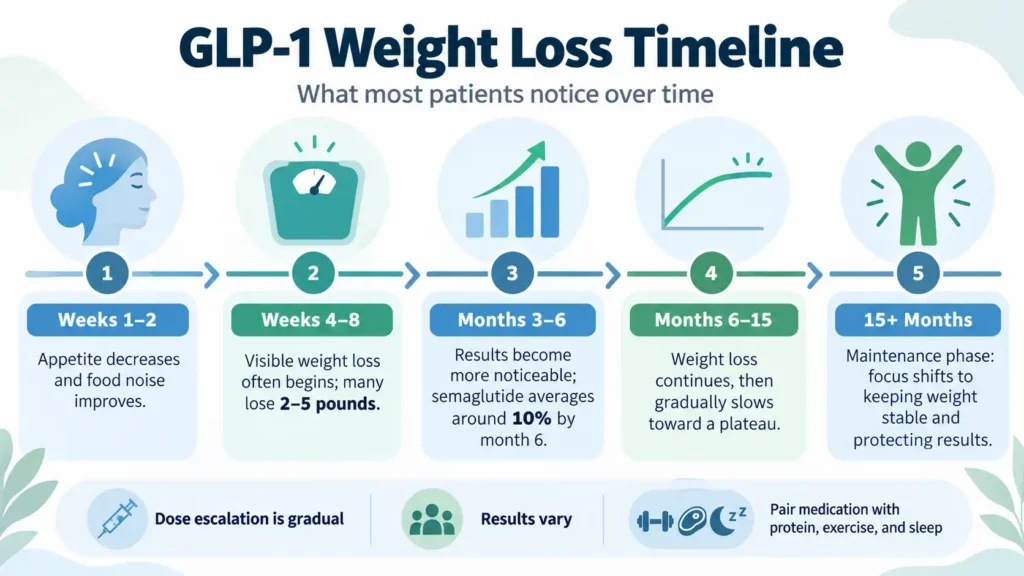
Weeks 1 to 2: Most patients notice appetite changes within the first week or two. Food noise decreases. Portions feel more satisfying. These early shifts happen before any visible weight loss shows up on the scale.
Weeks 4 to 8: Visible weight loss typically begins during this window. You’re still in the dose escalation phase (more on that below), so the medication hasn’t reached full strength yet. Most patients lose 2 to 5 pounds during this period, though individual results vary.
Months 3 to 6: This is where results become more noticeable. Clothes fit differently. Other people start commenting. Clinical trial data shows that the average patient on semaglutide 2.4 mg loses around 10% of body weight by month 6.
Months 6 to 15: Weight loss continues but gradually slows as you approach a plateau. The STEP 5 trial, which followed 304 adults on semaglutide for a full two years, found that weight loss plateaued around week 60 (roughly 14 months) and then held steady through week 104. The average total loss at two years was 15.2%.
Month 15 onward: You’re in the maintenance phase. Weight is stable. The medication continues working to prevent regain and maintain the metabolic improvements you’ve achieved.
One important note about dose escalation. You don’t start at the full dose. Semaglutide (Wegovy) begins at 0.25 mg weekly and increases every four weeks over 16 weeks until you reach the maintenance dose of 2.4 mg. Tirzepatide (Zepbound) follows a similar pattern over 20 weeks, starting at 2.5 mg and working up to 10 or 15 mg. Orforglipron (Foundayo) starts at 0.8 mg daily and increases at 30 day intervals. This gradual escalation minimizes side effects and gives your body time to adjust.
How Long Should You Stay on GLP-1 Medication
The clinical evidence points strongly toward long term use for most patients. Here’s why.
The STEP 5 trial is the longest published study on semaglutide for weight loss. Over 104 weeks (two full years), patients maintained a 15.2% average weight loss, with 77.1% losing at least 5% of their body weight and over half losing 15% or more. The trial had a 92.8% completion rate, which is exceptionally high for a two year study and speaks to both tolerability and patient satisfaction.
The SELECT trial went even further. It followed 17,604 patients for four years and found that semaglutide not only sustained roughly 10.2% weight loss over that entire period but also reduced major cardiovascular events by 20%. That’s four years of continuous data showing the medication remains safe and effective with ongoing use.
The major medical organizations have taken a clear position on this. The American Gastroenterological Association, the Endocrine Society, and the Obesity Medicine Association all treat obesity as a chronic condition, similar to high blood pressure or type 2 diabetes. Just as you wouldn’t stop blood pressure medication because your numbers improved, the same logic applies to weight management with GLP-1 therapy. The medication is treating an underlying metabolic condition, not just producing a temporary result.
That said, “indefinitely” doesn’t mean “without question.” Your provider should reassess your treatment regularly, evaluating whether the benefits still outweigh any risks, whether your dose needs adjustment, and whether you’ve built the lifestyle foundation that could eventually support a supervised taper.
What Happens When You Stop Taking GLP-1s
This is where the data gets uncomfortable, but it’s better to know upfront.
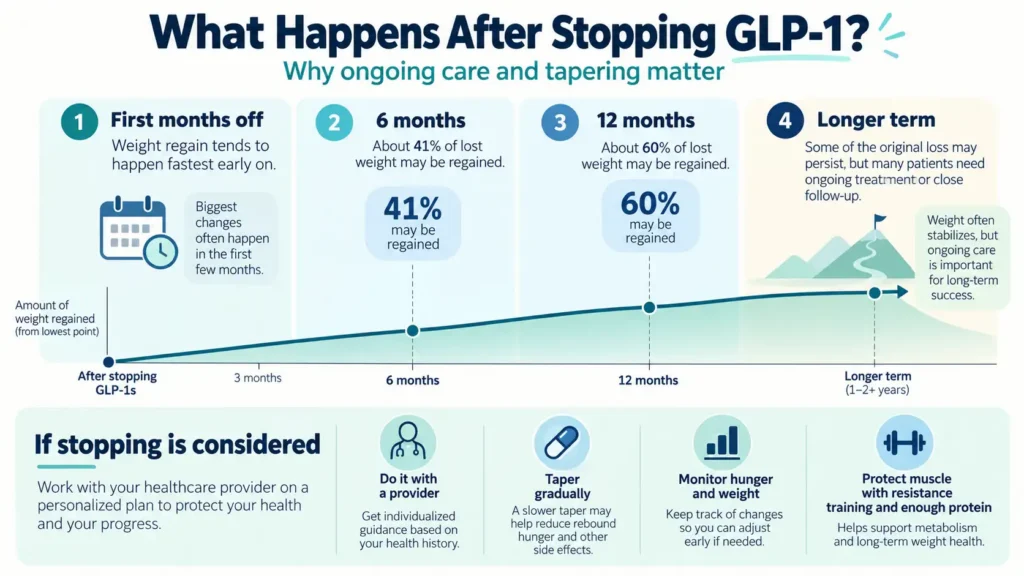
A 2026 meta regression published in eClinicalMedicine (part of The Lancet group) analyzed 44 studies and found that weight regain after stopping GLP-1 medication follows a predictable, nonlinear curve. The regain is fastest in the first few months and then gradually slows down.
Here’s what the numbers look like:
At 6 months after stopping, patients had regained approximately 41% of the weight they lost during treatment. At 12 months, that figure rose to about 60%. The mathematical model predicts a plateau at roughly 75.6% regained, meaning about 24% of the original weight loss may persist long term even without continued medication.
The STEP 4 trial confirmed this pattern. Patients who stopped semaglutide after 20 weeks of treatment regained 6.9% of body weight, while those who continued lost an additional 7.9%. The SURMOUNT 4 trial showed a similar regain pattern with tirzepatide.
It’s not just weight that comes back. Improvements in blood sugar, cholesterol, blood pressure, and inflammatory markers can also reverse when the medication is discontinued. The metabolic benefits are tied to the ongoing action of the drug.
Real world data paints a similar picture. Roughly 50% of patients discontinue GLP-1 medication within one year, and about 72% stop within two years. The most common reasons are cost, side effects (primarily nausea and GI discomfort during the early weeks), supply shortages, and the assumption that the weight loss will stick without continued treatment.
Can You Ever Stop Taking GLP-1 Medication
Yes, but the conditions matter.
Not every patient needs to stay on GLP-1 medication forever. Some people use it as a tool to break through a metabolic plateau, establish healthier eating patterns, and build an exercise routine that can sustain results independently. The key is being honest about whether those changes are genuinely in place before stepping away from the medication.
Based on current clinical practice, the criteria for considering a taper include being weight stable at your maintenance dose for at least 6 to 12 months with no further active weight loss after 18 to 24 months of therapy. Comorbidities like elevated blood sugar, high blood pressure, or abnormal cholesterol should be resolved or well controlled. You should have established consistent resistance training (at least three sessions per week), adequate protein intake (1.4 to 1.6 grams per kilogram of ideal body weight), and regular aerobic activity (250 or more minutes per week). Sleep quality and stress management should also be in a solid place.
Patients with type 2 diabetes, established cardiovascular disease, or significant metabolic dysfunction generally aren’t good candidates for stopping treatment. The same goes for anyone who has experienced rapid lean mass loss during treatment or who has a history of disordered eating.
If you and your provider decide that tapering makes sense, it should be done gradually. There’s no FDA approved tapering protocol, but the most common clinical approach involves stepping down one dose level every four weeks. For semaglutide, that means going from 2.4 mg to 1.7 mg, then to 1.0 mg, then to 0.5 mg, and finally to 0.25 mg before stopping completely. The entire taper takes about 20 weeks. During that time, your provider should monitor your weight weekly, track hunger levels, and adjust the plan if significant regain begins.
Why Muscle Preservation Matters During Treatment
This is an angle that doesn’t get nearly enough attention.
When you lose weight on a GLP-1 medication, not all of that loss is fat. Research published in JCI Insight in 2026 by investigators at Penn found that approximately 40% of the weight lost on GLP-1 therapy is lean mass (muscle), while 60% is fat. That ratio matters more than most people realize.
Muscle is metabolically active tissue. It burns calories at rest, supports joint health, protects against falls and fractures as you age, and plays a direct role in insulin sensitivity and blood sugar regulation. Losing too much muscle during treatment can lower your resting metabolic rate, making it even harder to maintain weight loss if you eventually stop the medication.
The Penn study also introduced the concept of a “muscle floor,” the idea that repeated stop and restart cycles can progressively lower your baseline muscle mass. Each time you stop, regain weight (which comes back predominantly as fat), and restart treatment, you may lose muscle you can’t easily rebuild. This is one of the strongest arguments against the “I’ll just use it for a few months” approach.
The good news is that resistance training during GLP-1 treatment can shift the ratio dramatically, from roughly 40% lean mass loss to closer to 20%. That’s a significant difference. If you’re on GLP-1 therapy, prioritizing strength training isn’t optional. It’s essential for protecting your long term metabolic health.
What does that look like in practice? At minimum, three resistance training sessions per week focusing on compound movements (squats, deadlifts, presses, rows). Protein intake should be at least 1.4 to 1.6 grams per kilogram of ideal body weight per day, spread across meals rather than loaded into one sitting. That might mean 25 to 40 grams of protein per meal for most people. If you’re losing weight rapidly but your strength is declining, that’s a signal to talk with your provider about adjusting your approach.
Your nutritional status also plays a role. Adequate protein intake, micronutrient support, and personalized dietary guidance can help preserve lean mass throughout the treatment process. Some patients benefit from working with a provider who can assess their metabolic profile and adjust nutrition recommendations based on individual lab work rather than generic guidelines.
Semaglutide vs. Tirzepatide vs. Orforglipron: How They Compare
With three main GLP-1 options now available, understanding the differences helps put the “how long” question in better context.
| Semaglutide (Wegovy) | Tirzepatide (Zepbound) | Orforglipron (Foundayo) | |
|---|---|---|---|
| How it works | GLP-1 receptor agonist | Dual GLP-1 and GIP agonist | Oral nonpeptide GLP-1 agonist |
| Administration | Weekly injection or daily oral tablet | Weekly injection | Daily oral pill |
| Dose escalation | 16 weeks (0.25 mg to 2.4 mg) | 20 weeks (2.5 mg to 15 mg) | ~4 to 6 months (0.8 mg to 17.2 mg) |
| Trial weight loss | 15.2% at 2 years (STEP 5) | Up to 22.5% at 72 weeks (SURMOUNT 1) | Up to 12.4% at 72 weeks (ATTAIN 1) |
| Longest trial data | 4 years (SELECT) | 3.5 years | 72 weeks |
| Cardiovascular data | 20% MACE reduction (SELECT) | Trials ongoing | Not yet studied |
| Refrigeration needed | Yes (injection); No (oral) | Yes | No |
| FDA approved for weight loss | Yes (2021) | Yes (2023) | Yes (April 2026) |
Each medication has its strengths. Tirzepatide produces the greatest weight loss in clinical trials. Semaglutide has the longest safety record, including the four year SELECT trial proving cardiovascular benefit. Orforglipron offers the most convenient delivery (a daily pill with no injection, no refrigeration, and no food or water timing restrictions), though its weight loss numbers are more modest.
The choice between them should be based on your specific health profile, preferences, and goals, which is exactly why working with a provider who understands metabolic health and hormone optimization matters.
What Affects How Long You Stay on Treatment
Several factors influence your personal treatment timeline.
Your starting point matters. Patients with higher BMIs, more significant metabolic dysfunction, or longer histories of weight cycling tend to need longer treatment to achieve and sustain results. Someone starting at a BMI of 38 with insulin resistance has a different trajectory than someone at BMI 31 with no metabolic complications. Your dietary habits also influence the timeline. For example, understanding how different foods affect your metabolism and making informed choices can accelerate progress alongside medication.
Hormonal factors play a role. Women going through perimenopause or menopause often face compounding metabolic challenges. Declining estrogen affects body composition, insulin sensitivity, and fat distribution. GLP-1 therapy in this context may need to be paired with hormone optimization for the best long term outcomes.
Cost is a real factor. Across the industry, GLP-1 medications for weight loss generally range from $300 to $1,350 per month depending on the specific medication, pharmacy, and whether insurance covers it. These are general industry figures that vary significantly by provider and location. Medicare’s new Bridge Program, which launched in July 2026, now covers Wegovy, Zepbound, and Foundayo at a $50 monthly copay for eligible patients. Many commercial insurance plans also cover GLP-1s for weight loss with prior authorization, and manufacturer savings programs can bring the cost down substantially for eligible patients.
For a personalized cost estimate based on your insurance and clinical profile, scheduling a consultation is the best starting point.
Side effects influence adherence. Nausea, constipation, and diarrhea are most common during the dose escalation phase and typically improve within the first few months. The STEP 5 trial reported that only 3.9% of patients discontinued due to side effects over two full years, which tells you that the vast majority of people tolerate these medications well with proper management. If nausea is an issue during escalation, eating smaller meals, avoiding high fat foods, and staying hydrated can make a noticeable difference. Your provider can also slow the dose escalation timeline if needed.
Lifestyle foundations determine long term success. Patients who build consistent exercise habits, prioritize protein intake, address sleep quality, and work on stress management tend to have better outcomes whether they stay on medication or eventually taper off. GLP-1 therapy works best as part of a comprehensive approach, not as a standalone solution. That includes addressing any underlying hormonal imbalances, nutritional deficiencies, or metabolic issues that may be contributing to weight gain in the first place.
Understanding how your body processes food at a genetic level and whether hormonal shifts are working against you can help your provider design a treatment plan that addresses root causes, not just symptoms. Patients who combine GLP-1 therapy with this kind of comprehensive metabolic approach tend to see results that last because they aren’t relying on the medication to do all the work.
Frequently Asked Questions
How long does it take GLP-1 to start working for weight loss?
Most patients notice reduced appetite and less food noise within the first one to two weeks. Visible weight loss on the scale typically begins between weeks 4 and 8, though you’re still in the dose escalation phase at that point. The most significant results develop over 6 to 15 months as you reach and maintain the full therapeutic dose.
What happens if you stop taking semaglutide?
Clinical data shows that most patients regain approximately 60% of their lost weight within 12 months of stopping semaglutide. A 2026 meta regression in eClinicalMedicine (Lancet group) found that regain is fastest in the first five to six months and then gradually slows. Metabolic improvements in blood sugar, cholesterol, and blood pressure can also reverse.
Can you take GLP-1 medications forever?
There is no FDA mandated maximum treatment duration. The longest published trial data (SELECT) covers four years of continuous semaglutide use with sustained weight loss and a 20% reduction in cardiovascular events. The WHO’s 2025 Cochrane reviews noted that long term data beyond three years is still limited, but what exists is reassuring. Your provider should reassess treatment periodically to confirm the benefits continue to outweigh any risks.
How much weight can you lose on GLP-1 in 3 months?
Results vary, but clinical trial averages show 5 to 10% body weight loss within the first three months on semaglutide. Tirzepatide may produce slightly more. Keep in mind that you’re still in the dose escalation phase during much of this period, so weight loss accelerates after you reach the full maintenance dose.
Do you gain all the weight back after stopping Wegovy?
Not all of it, but most of it. The eClinicalMedicine 2026 analysis found that the mathematical plateau sits at about 75.6% of lost weight regained, meaning roughly 24% of the weight loss may persist long term even without continued medication. However, patients who’ve built strong lifestyle habits before stopping tend to retain more of their results.
Is tirzepatide better than semaglutide for long term use?
Tirzepatide produced greater weight loss in head to head trials (SURMOUNT 5), with results up to 22.5% at 72 weeks compared to semaglutide’s 15.2% at 104 weeks. However, semaglutide has longer safety data (four years via SELECT) and is the only GLP-1 with proven cardiovascular outcome benefits. The “better” choice depends on your specific health profile and goals.
How do you know when to stop GLP-1 medication?
The clinical criteria include weight stability at your maintenance dose for 6 to 12 months, resolved comorbidities, established resistance training and high protein intake, and consistent aerobic activity of 250 or more minutes per week. Your provider should guide any tapering decision and monitor closely during the transition. Abrupt stopping is not recommended.
Does insurance cover long term GLP-1 use for weight loss?
Coverage has expanded significantly. Medicare’s Bridge Program (launched July 2026) covers Wegovy, Zepbound, and Foundayo at a $50 monthly copay for eligible beneficiaries. Many commercial plans now cover GLP-1s for weight loss with prior authorization. Manufacturer savings programs can also reduce costs. Coverage specifics vary by plan, so check with your insurance provider or ask during your consultation.