

You should consider testosterone replacement therapy when all three of these are true: you have persistent symptoms of low testosterone (low sex drive, chronic fatigue, mood changes, muscle loss), two separate fasting morning blood tests confirm your levels are below 300 ng/dL, and lifestyle changes like improving sleep, exercise, and weight management haven’t resolved your symptoms after 8-12 weeks. TRT is FDA-approved only for men with medically diagnosed hypogonadism — not for normal aging, general tiredness, or performance enhancement.
That’s the short answer. But there’s a lot more to this decision than a one-paragraph summary, and getting it wrong in either direction has real consequences.
About 40% of men over 45 have clinically low testosterone levels, yet many of them can raise those numbers through lifestyle changes alone. Others truly need medical treatment and waiting too long can cost them years of unnecessary suffering. TRT prescriptions jumped from 7.3 million in 2019 to over 11 million by 2024, so you’re far from alone in asking this question.
The harder question is: which camp do you fall into?
That’s what this guide breaks down — the clinical criteria, the step-by-step decision framework, and the honest truth about when TRT makes sense and when it doesn’t. No sales pitch, no scare tactics.
What Testosterone Replacement Therapy Actually Does (And What It Doesn’t)
Before we get into timing, let’s clear up what TRT is and isn’t.
TRT replaces the testosterone your body isn’t producing enough of on its own. It’s FDA-approved specifically for men diagnosed with hypogonadism — a medical condition where the testes or the brain signals controlling them aren’t working properly. It comes in several forms: injections, topical gels, skin patches, implanted pellets, and oral capsules.
What TRT is not:
- It’s not the same as anabolic steroids used for bodybuilding (those involve supraphysiological doses — far above what your body naturally makes)
- It’s not an anti-aging miracle drug
- It’s not FDA-approved for normal, age-related testosterone decline without symptoms
- It’s not a substitute for fixing sleep, diet, exercise, and stress
That last point matters more than most guys realize. A lot of the symptoms people blame on “low T” — brain fog, low energy, weight gain — overlap almost perfectly with poor sleep, chronic stress, and metabolic issues. That’s why the diagnostic process exists: to figure out what’s actually driving your symptoms before jumping to treatment.
5 Signs It’s Time to Get Your Testosterone Checked
You don’t need to guess whether your testosterone is low. But certain patterns should send you to get bloodwork done sooner rather than later.
1. Your Sex Drive Dropped Off a Cliff — And It’s Not Coming Back
We’re not talking about an occasional slow week. This is a persistent, noticeable drop in sexual desire that’s lasted months. You used to think about sex regularly. Now? Barely crosses your mind. Morning erections have become rare or stopped entirely. Erectile function has declined even when you’re interested.
Testosterone is the primary driver of male libido. When levels drop significantly, this is often the first and most obvious symptom men notice.
2. You’re Exhausted in a Way That Sleep Can’t Fix
Everyone gets tired. That’s not what we’re talking about. Low testosterone fatigue feels different — it’s a bone-deep exhaustion that persists even after a full night’s sleep. You wake up feeling like you haven’t rested. By 2 PM, you’re running on fumes. Activities that used to energize you now feel like a chore.
If you’re sleeping 7-9 hours, your thyroid is normal, and you’re still dragging through every day, low T deserves a spot on the list of suspects.
3. Your Mood Has Shifted and You Can’t Pinpoint Why
Irritability that seems out of proportion. A low-grade depression that isn’t tied to any life event. Difficulty concentrating on work you used to handle without thinking. Motivation that’s just… gone.
Testosterone plays a direct role in mood regulation, and these mental health symptoms often get misdiagnosed as depression or anxiety before anyone thinks to check hormone levels. If antidepressants haven’t helped or the symptoms don’t match a clear psychological pattern, hormone testing makes sense.
4. You’re Losing Muscle and Gaining Fat Despite Working Out
You’re still hitting the gym. You’re eating reasonably well. But you’re watching muscle mass slowly disappear while body fat — particularly around your midsection — keeps accumulating. Your strength numbers are dropping for no clear reason.
Testosterone is the primary anabolic hormone driving muscle protein synthesis. When levels fall below normal range, your body shifts from building muscle to storing fat, regardless of how consistent your training is.
5. Bone Density Issues or Unexplained Fractures
This one flies under the radar for most men. Testosterone helps maintain bone mineral density, and prolonged deficiency increases fracture risk. If you’ve had a stress fracture that seemed disproportionate to the activity, or a bone density scan came back lower than expected for your age, low testosterone should be investigated.
The bottom line: One symptom in isolation isn’t necessarily a low-T problem. But if you’re stacking two or three of these on top of each other and they’ve persisted for months, it’s time to get bloodwork done. Not to confirm a diagnosis — but to rule it in or out so you stop guessing.
How Low Testosterone Is Actually Diagnosed
This is where a lot of men (and frankly, a lot of clinics) cut corners. Proper diagnosis isn’t a single blood draw and a prescription. Here’s what should actually happen.
The Two-Test Morning Protocol
Your testosterone needs to be measured on two separate mornings, drawn between 7 and 10 AM when levels naturally peak. Fasting is required because food intake can lower testosterone readings by up to 25%.
Why two tests? Because testosterone fluctuates significantly day to day. The Endocrine Society found that roughly 30% of men with an initially low result will show normal levels on a retest. That means one out of three guys who’d get a TRT prescription based on a single test might not actually need it.
Both tests need to come back below 300 ng/dL (that’s the threshold used by the American Urological Association and confirmed by the American Academy of Family Physicians in their 2024 updated guideline). Some men fall in a gray zone between 300-450 ng/dL — more on that in a minute.
The Full Picture: Blood Tests Beyond Testosterone
A single testosterone number doesn’t tell the whole story. A thorough evaluation should include:
| Test | Why It Matters |
|---|---|
| Total testosterone (AM, fasting) | Primary diagnostic number |
| Free testosterone | Shows how much T your body can actually use — you can have borderline total T but critically low free T |
| SHBG (sex hormone-binding globulin) | Binds testosterone and makes it inactive. High SHBG = less usable testosterone even if total T looks okay |
| LH and FSH | Tells your doctor whether the problem is in your testes (primary) or your brain’s signaling (secondary) |
| Prolactin | Rules out pituitary tumors that can suppress testosterone |
| Estradiol | Elevated estrogen in men can mimic low-T symptoms |
| CBC / Hematocrit | Baseline — TRT can increase red blood cell production |
| PSA | Prostate cancer screening baseline |
| Thyroid panel | Thyroid problems mimic low-T symptoms almost exactly |
| HbA1c / fasting glucose | 30-50% of men with Type 2 diabetes also have low testosterone |
| Lipid panel | Cardiovascular risk baseline |
If a clinic offers to diagnose you based on a single afternoon blood draw and a symptom checklist — without running this full panel — that’s a red flag.
In our clinic, Dr. Elrod orders this complete workup before even discussing treatment options. “I’ve seen too many men come in already on TRT from an online clinic, but nobody ever checked their thyroid or screened them for sleep apnea,” he says. “Half the time, we find something fixable that was missed because the first provider skipped the basics.”
The Borderline Zone: 300-450 ng/dL
Here’s something most articles skip over entirely: what happens if your total testosterone is technically above 300 ng/dL but you’re still symptomatic?
This is the borderline zone, and it affects a lot of men. Your total testosterone might read 380 ng/dL — technically “normal” — but your free testosterone could be critically low because elevated SHBG is binding most of it. Up to 20% of men with total testosterone above 300 have low bioavailable testosterone, according to data compiled from the AUA guidelines.
If you’re symptomatic and your total T is in this gray area, your doctor should check free testosterone and SHBG levels. These two numbers often explain why you feel terrible despite a “normal” total testosterone reading.
The 6-Step TRT Decision Framework
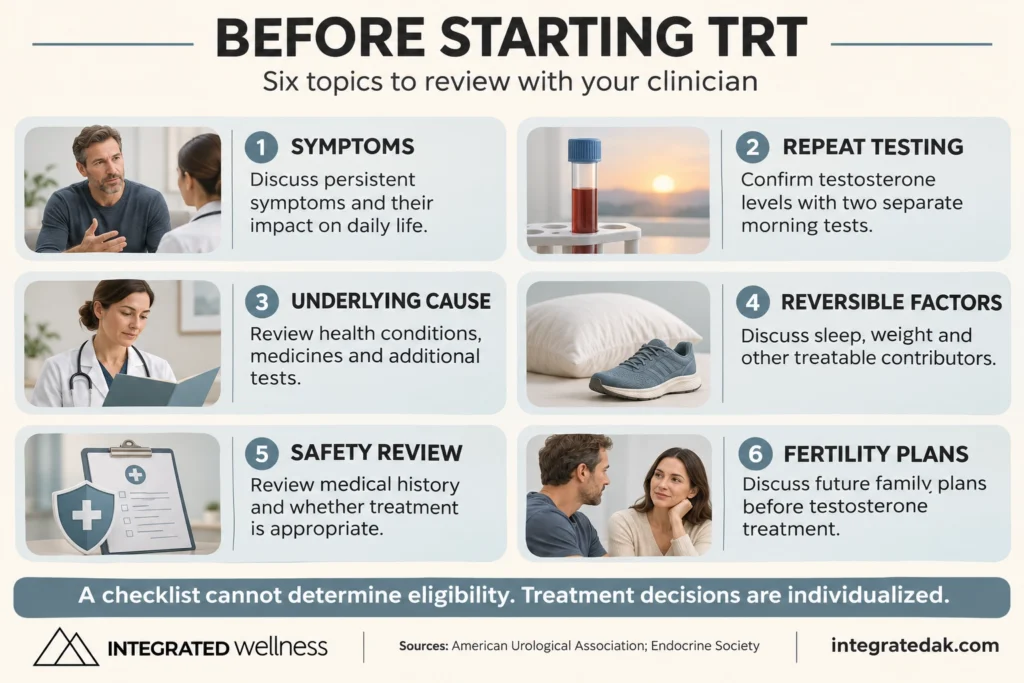
This is the part that matters most. Instead of asking “should I get TRT?” as a yes-or-no question, walk through these six steps in order. Each one either moves you closer to treatment or points you toward something else first.
Step 1: Are Your Symptoms Persistent and Significant?
Keyword: persistent. A bad week doesn’t count. A rough month after a stressful project doesn’t count. We’re talking about symptoms that have been present for at least several months, that aren’t explained by an obvious life circumstance, and that are meaningfully affecting your quality of life.
If your symptoms started suddenly, that actually points more toward an acute medical issue (thyroid crash, medication side effect, pituitary problem) than gradual hypogonadism. Sudden onset deserves urgent evaluation regardless.
Step 2: Do Two Morning Blood Tests Confirm Low T?
Both fasting morning draws below 300 ng/dL? That confirms biochemical hypogonadism. Both above 300? Low testosterone probably isn’t your issue — look at thyroid, sleep, stress, medication effects, and mental health.
One low, one normal? That’s why we test twice. The 30% retest normalization rate is real. Your doctor may recommend a third test or dive deeper into free T and SHBG.
Step 3: What Type of Hypogonadism Do You Have?
This distinction matters because it changes the treatment approach:
| Type | What’s Happening | Testosterone | LH/FSH Levels | Typical Causes | First-Line Treatment |
|---|---|---|---|---|---|
| Primary | Testes can’t produce enough T even though the brain is signaling correctly | Low | High (brain is screaming at the testes) | Testicular injury, Klinefelter syndrome, chemo/radiation, mumps orchitis | TRT |
| Secondary | Brain isn’t sending the right signals to the testes | Low | Low or normal | Pituitary tumor, obesity, opioid use, head trauma, sleep apnea | Address root cause first; then TRT or clomiphene |
| Functional | Nothing is structurally wrong — lifestyle factors are suppressing production | Low | Variable | Obesity, chronic stress, sleep deprivation, excessive alcohol, medications | Lifestyle optimization for 8-12 weeks first |
If your hypogonadism is functional (and that’s the most common type in otherwise healthy men), jumping straight to TRT skips a step that could resolve your symptoms without lifelong medication.
Step 4: Have You Tried Lifestyle Changes First?
For functional hypogonadism, every major medical guideline recommends 8-12 weeks of targeted lifestyle optimization before considering TRT. And the data backs this up — it’s not just lip service.
Weight management is the single biggest lever. Losing 10-15% of your body weight can increase testosterone by 100-200 ng/dL — enough to push many men from deficient back into normal range. That’s not a typo. For a 250-pound man, losing 25-37 pounds could potentially add 100-200 points to his testosterone reading. (For men also exploring medical weight management options, we cover how GLP-1 medications work and how long you take them.)
Here’s what an 8-12 week lifestyle trial looks like:
- Resistance training 3-4 times per week — compound movements like squats, deadlifts, bench press, and rows. These produce the strongest testosterone response. Avoid overtraining with excessive endurance exercise, which can actually lower testosterone.
- Sleep optimization — 7-9 hours nightly, consistent schedule. Sleeping less than 6 hours drops testosterone 10-15%. If you snore or wake up gasping, get screened for sleep apnea — it both mimics and worsens low T.
- Nutrition overhaul — adequate protein, healthy fats, and key micronutrients (zinc, vitamin D, magnesium). Limit alcohol — it’s a direct testicular toxin. Manage blood sugar, because insulin resistance actively suppresses testosterone production.
- Medication review — opioids, corticosteroids, finasteride, and certain antidepressants can all suppress testosterone. Talk to your prescribing doctor about alternatives.
- Stress management — chronic cortisol elevation directly antagonizes testosterone. This isn’t a soft recommendation. It’s biochemistry.
After 8-12 weeks, retest. If your levels are still below 300 ng/dL with persistent symptoms despite meaningful lifestyle changes, you’ve now ruled out the fixable stuff. That’s when TRT enters the conversation with solid clinical justification.
Dr. Elrod takes this step seriously with every patient. “I’d rather spend 8 weeks helping a man fix his sleep and lose some weight than put him on a medication he might not need for the rest of his life,” he explains. “And when we do that work first and his levels are still low — now we know TRT is the right call, not just the convenient one.”
Step 5: Have Contraindications Been Ruled Out?
Before starting TRT, certain conditions must be screened for and cleared (per the Cleveland Clinic and AUA guidelines):
Absolute contraindications — TRT should NOT be started:
- Active or untreated prostate cancer
- Male breast cancer
- Desire for near-future fertility (without a preservation plan — more on this below)
- Untreated severe obstructive sleep apnea
- Uncontrolled or unstable heart failure
- Hematocrit above 50%
- Heart attack or stroke within the past 6 months
- Unevaluated prostate nodule or significantly elevated PSA
Conditions requiring specialist evaluation first:
- History of treated prostate cancer (growing evidence supports safety with oversight)
- Severe lower urinary tract symptoms from BPH
- History of elevated red blood cell counts
- Severe kidney or liver disease
If you have any of these, that doesn’t necessarily mean TRT is off the table forever. It means you need a specialist involved in the decision, not just a quick-prescribe clinic.
Step 6: Have You Addressed Fertility?
This is the step most men don’t hear about until it’s too late. TRT suppresses sperm production — most men on standard TRT develop azoospermia (zero sperm count) within about 4 months. It essentially acts as a male contraceptive.
If you might want children in the future — even if it’s not on your radar right now — you need to address this before starting treatment:
| Option | How It Works | Preserves Fertility? |
|---|---|---|
| Sperm banking before TRT | Freeze samples before treatment starts | Yes — gold standard |
| Clomiphene citrate | Stimulates your brain to signal more T production naturally | Yes — boosts both T and sperm |
| hCG (human chorionic gonadotropin) | Mimics LH to keep testes producing | Yes — often used alongside TRT |
| Low-dose hCG + TRT | Combines external T with testicular stimulation | Partial — may preserve some sperm |
| Enclomiphene | Newer selective estrogen receptor modulator | Yes — emerging alternative |
Most men do recover sperm production after stopping TRT, but it can take 12-24 months, and recovery isn’t guaranteed — especially with longer duration use and older age.
This is a conversation Dr. Elrod has with every man under 50 who walks through the door. “I always ask about family plans, even if the guy says he’s done having kids. Life changes. Relationships change. We bank sperm or look at clomiphene first — it’s a small step now that prevents a devastating problem later.”
Your Decision Checkpoint
After working through all six steps, you should land in one of three places:
✅ Ready for TRT — Confirmed hypogonadism on two tests, persistent symptoms impacting quality of life, lifestyle changes attempted, no contraindications, fertility addressed.
⏸️ Not yet — Lifestyle trial hasn’t been completed, only one blood test done, or a treatable underlying cause (thyroid, sleep apnea, medication) hasn’t been addressed.
🔄 Alternative approach — Fertility is a priority (consider clomiphene or hCG), or symptoms are borderline and watchful waiting with monitoring makes more sense.
TRT Delivery Methods: Comparing Your Options
If you and your doctor decide TRT is the right call, the next question is how you’ll take it. Each method has real trade-offs.
| Method | How It Works | Frequency | Avg Cost/Month (No Insurance) | Key Advantage | Key Drawback |
|---|---|---|---|---|---|
| Injections (IM or subcutaneous) | Self-inject at home | Weekly or biweekly | $20-105 (generic cypionate) | Cheapest option by far; precise dosing | Peaks and valleys between doses; injection site reactions |
| Topical gel (AndroGel, Testim) | Apply to shoulders/arms daily | Daily | $400-1,000 | Steady hormone levels; non-invasive | Transfer risk to partners/kids through skin contact; expensive |
| Patches (Androderm) | Apply to skin nightly | Daily | ~$800 | Steady absorption | Common skin irritation; can detach |
| Pellets (Testopel) | Implanted in-office under the skin | Every 3-6 months | ~$1,200 per insertion | Most consistent levels; lowest maintenance | In-office procedure; can’t easily adjust dose mid-cycle |
| Oral capsules (Jatenzo, Kyzatrex) | Take with a fatty meal | Twice daily | $900-1,200 | No needles or gels | Blood pressure increase (~5 mmHg systolic per FDA); must take with food; expensive |
| Nasal gel (Natesto) | Spray into each nostril | 3 times daily | $400-600 | No transfer risk; may preserve some sperm production | Inconvenient dosing schedule; nasal irritation |
A pricing reality check: Generic testosterone cypionate injections cost $20-105 per month without insurance. Brand-name gels can run $400-1,000+. That’s a 5-10x price difference for essentially the same hormone. If cost is a factor — and for most people it is — injections are the most accessible option by a wide margin.
Insurance coverage varies, but most plans cover medically necessary TRT when you have documented hypogonadism (two low blood tests + symptoms + a diagnosis code). Generic injectables typically sit on the lowest copay tier. Some men also ask about bioidentical hormone therapy as an alternative — we address the safety and evidence around that in our article on whether bioidentical hormone therapy is safe.
What to Expect: The TRT Results Timeline
One of the most common questions is “how fast will I feel better?” Based on a landmark 2011 study by Saad and colleagues published in the European Journal of Endocrinology, the clinical data breaks down like this:
| What Improves | When You’ll First Notice | Full Effect |
|---|---|---|
| Sex drive | 3-4 weeks | Plateau around 6 weeks |
| Energy and fatigue | 3-6 weeks | Varies, but most men feel it early |
| Erectile function | Interest improves 3-6 weeks; function may take up to 6 months | 6 months |
| Mood and motivation | 3-6 weeks (onset) | Full benefit at 18-30 weeks |
| Body composition | 12-16 weeks | Ongoing improvement through 6-12 months |
| Lipid profile | 4 weeks | 6-12 months |
| Bone density | 6 months | Continuous improvement over 3+ years |
| Blood sugar / insulin sensitivity | 3-12 months | 12 months |
The 3-6 month checkpoint is critical. If you’ve been on TRT for 3-6 months, your blood levels have normalized, and you still aren’t feeling meaningfully better — TRT probably isn’t the answer to your symptoms. The AUA recommends reassessing and potentially discontinuing at that point. As endocrinologist Karen Herbst, MD, PhD told WebMD: about 1 in 10 men are “ecstatic” with TRT results, while about 1 in 10 “don’t notice much difference.” Most men fall somewhere in between.
The 2025 FDA Safety Update: What You Should Know
For about a decade, testosterone products carried a black box warning about potential cardiovascular risks — heart attack and stroke. That changed in a big way in February 2025.
What happened: On February 28, 2025, the FDA removed the cardiovascular black box warning from all testosterone products. This decision was based primarily on the TRAVERSE trial — the largest cardiovascular safety study of TRT ever conducted.
The TRAVERSE trial numbers:
- 5,204 men aged 45-80 with hypogonadism AND preexisting cardiovascular risk
- Randomized to testosterone gel or placebo
- Primary outcome: major adverse cardiac events (MACE) occurred in 7.0% of the testosterone group vs. 7.3% of the placebo group
- Hazard ratio: 0.96 (95% CI: 0.78-1.17) — statistically noninferior
In plain English: TRT did not increase heart attack or stroke risk compared to placebo, even in men who already had heart disease risk factors. That’s a significant finding that changes the risk-benefit conversation for millions of men.
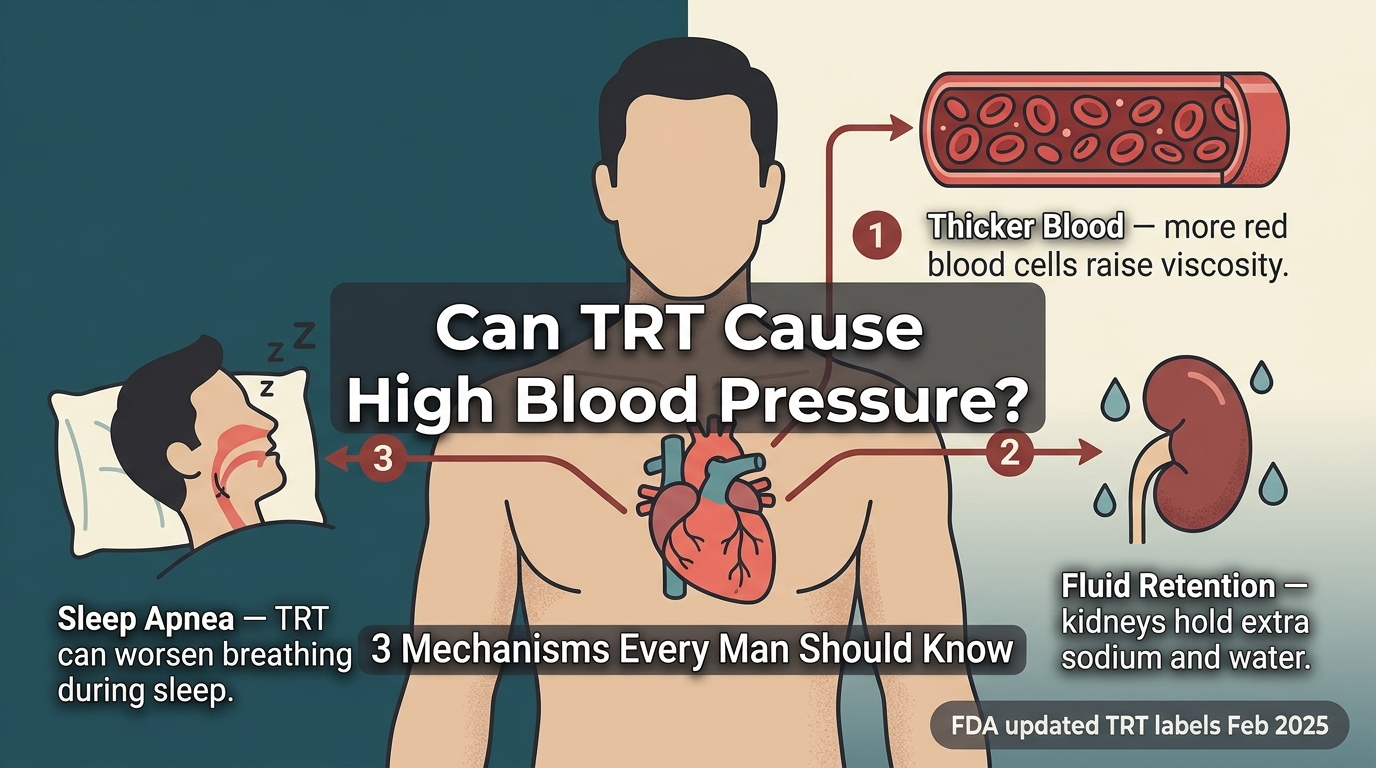
What the FDA added instead: A new class-wide blood pressure warning. Studies using ambulatory blood pressure monitoring confirmed that testosterone products — especially oral formulations — can raise blood pressure. Oral testosterone capsules showed about a 4.9 mmHg increase in systolic blood pressure. That’s manageable for most men, but it means blood pressure should be monitored regularly on TRT. (We break this down further in our article on whether TRT can cause high blood pressure.)
Safety signals to still watch for: The TRAVERSE trial did find slightly higher rates of pulmonary embolism (0.9% vs. 0.5%), atrial fibrillation, and acute kidney injury in the testosterone group. These weren’t the primary endpoints, but they’re worth monitoring.
What this means for you: The cardiovascular scare that kept many men away from TRT for 10 years was based on weaker data that this large, rigorous trial didn’t confirm. That said, TRT isn’t risk-free — blood pressure, blood counts, and prostate markers still need regular monitoring.
What Happens If You Stop TRT
A fair question that doesn’t get enough honest answers: is TRT a lifelong commitment?
For many men, yes — if you have true hypogonadism caused by a permanent medical condition, stopping TRT means your levels will fall back to where they were and symptoms will return.
But not always. A study of 151 men who stopped TRT (cited by WebMD) found:
- 39% maintained their improvements — these men had been on TRT longer (average 10.7 months vs. 5 months) and exercised regularly
- 61% reverted to their pre-treatment baseline
The takeaway? Exercise during TRT appears to help sustain benefits if you eventually stop. And longer treatment duration before discontinuation may actually improve your chances of maintaining gains.
If you’re considering stopping TRT:
- Taper gradually under medical supervision — don’t quit cold turkey
- Some providers bridge with clomiphene or hCG to restart natural production
- Expect recovery of natural testosterone production to take weeks to months
- Longer TRT use generally means longer recovery time
- The American College of Physicians recommends reassessing after 1 year for men with age-related low T — if sexual function hasn’t improved, discontinuation should be discussed
10 Questions to Ask Your Doctor Before Starting TRT
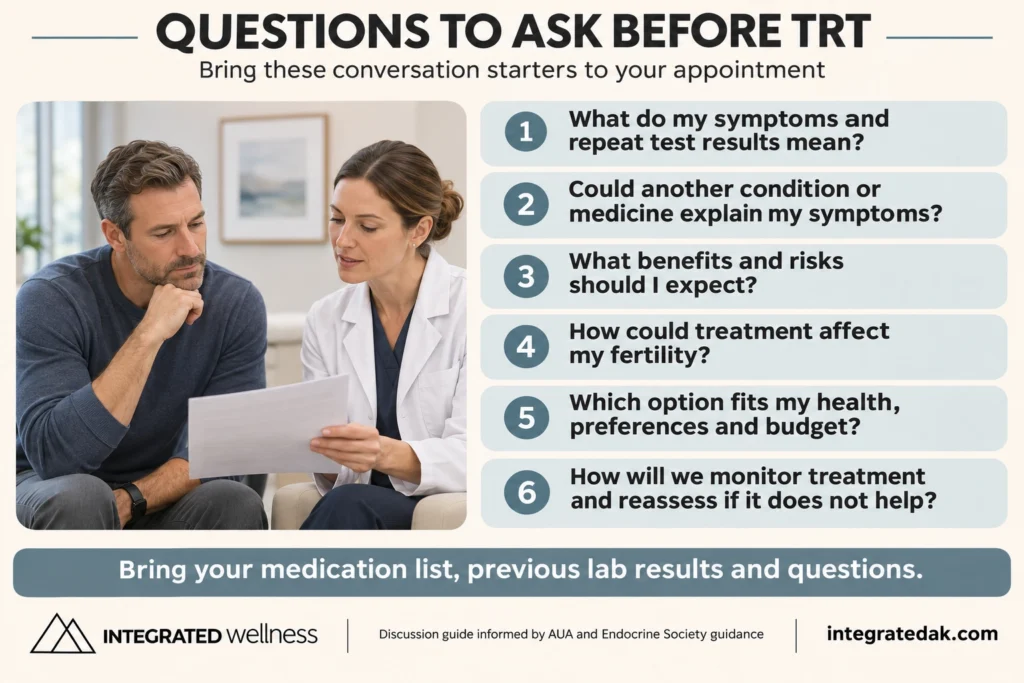
Print this list. Bring it to your appointment. A doctor who takes TRT seriously will welcome these questions and if they seem annoyed or dismissive, that tells you something too.
- What were my exact testosterone levels on both tests? (You deserve the actual numbers, not just “it’s low.”)
- Is my low T caused by a specific medical condition, or is it age-related? (This affects whether TRT is FDA-approved for your situation.)
- Have we ruled out thyroid problems, sleep apnea, and medication effects? (All three can mimic low-T symptoms almost perfectly.)
- Should I try lifestyle changes first, and for how long? (If your doctor says no without explanation, ask why.)
- Which TRT delivery method do you recommend for my situation, and why? (There should be a reason beyond “this is what we usually prescribe.”)
- What does monitoring look like — how often will I need blood work? (Expect at minimum: 1 month, 3 months, 6 months, then every 6-12 months.)
- What side effects should I watch for between visits? (Acne, mood changes, breast tenderness, ankle swelling, breathing problems during sleep.)
- How will this affect my fertility, and should I bank sperm first? (If your doctor doesn’t bring this up, you should.)
- What happens if TRT doesn’t improve my symptoms after 3-6 months? (A good doctor has a plan B.)
- Will my insurance cover this, and what documentation do I need? (Two morning blood tests + symptoms + hypogonadism diagnosis code = the standard insurance requirement.)
Frequently Asked Questions
At what testosterone level should you start TRT?
Below 300 ng/dL on two separate fasting morning blood draws — that’s the threshold the AUA uses, and the 2024 AFP guideline confirmed it. But here’s the thing: a number alone doesn’t get you a prescription. You also need persistent symptoms that match.
Some men feel fine at 280 ng/dL. Others are miserable at 350 because their free testosterone is in the gutter while total T looks “normal.” That’s why total testosterone, free testosterone, and SHBG all need to be checked together. A single number on a single test isn’t enough to make this call.
Can you get TRT in your 20s or 30s?
Yes — age isn’t the disqualifier. If you have documented hypogonadism with two confirmed low tests, you’re a candidate regardless of whether you’re 28 or 58. The bigger issue for younger men is fertility. TRT will likely tank your sperm count, and at 30, your family planning picture probably looks different than at 55. That’s why clomiphene is often the first choice in this age group — it raises testosterone without shutting down sperm production.
How long does TRT take to start working?
Sex drive usually kicks in first — 3-4 weeks. Energy follows around 3-6 weeks. Body changes are slower: 12-16 weeks before you see real shifts in muscle and fat. Mood is the longest play — full benefit can take 18-30 weeks.
The 3-6 month checkpoint matters. If your blood levels are normalized and you still feel the same, TRT probably isn’t your answer.
Is TRT a lifelong commitment?
Depends. If your testes are permanently damaged (primary hypogonadism), then yes — they’re not going to start producing more on their own. But if your low T is driven by obesity, medications, or lifestyle (functional hypogonadism), there’s a real chance you could taper off after addressing the root cause. One study found 39% of men maintained their improvements after stopping, especially those who kept exercising during treatment.
Not exactly a coin flip, but better odds than most people assume.
Does insurance cover TRT?
Usually, yes — if you have the right documentation. That means two low morning testosterone tests, symptoms on record, and a hypogonadism diagnosis code. Generic testosterone cypionate injections are typically on the lowest copay tier, so out-of-pocket costs are minimal for most insured patients.
Where it gets tricky: brand-name gels and patches sit on higher tiers with bigger copays, some plans require prior authorization, and if your diagnosis is strictly age-related decline without an underlying medical condition, coverage varies significantly by insurer. Worth a call to your insurance company before assuming.
Can TRT cause hair loss?
It can — but only if you’re already genetically predisposed to male-pattern baldness. Testosterone converts to DHT, the hormone that shrinks hair follicles. If your dad and your grandpa both lost their hair, TRT might speed up what was already coming. If hair loss doesn’t run in your family, it’s unlikely to be an issue. Talk to your doctor about it before starting so there aren’t surprises.
Will TRT make me aggressive?
No. This myth comes from steroid abuse, not medical TRT.
At therapeutic doses — the kind that bring you back to normal range, not above it — studies consistently show improved mood stability, not aggression. The “roid rage” people reference involves supraphysiological doses (5-10x normal levels) used for bodybuilding. That has nothing to do with replacing what your body should be making on its own.
What’s the difference between TRT and anabolic steroids?
Dose and intent. TRT replaces testosterone to bring you within normal physiological range (roughly 300-1,000 ng/dL) under medical supervision with regular bloodwork monitoring. Steroid abuse pushes levels far above normal for performance enhancement, typically without medical oversight.
Same molecule. Completely different ballgame. We break this down in detail in our article on whether TRT is a steroid.
Can I still have kids while on TRT?
Not easily. Standard TRT suppresses sperm production — most men hit zero sperm count within about 4 months. It’s essentially a male contraceptive at therapeutic doses.
But you’ve got options if fertility matters to you: bank sperm before starting, use clomiphene instead (raises T without killing sperm), add hCG alongside TRT to keep the testes working, or try nasal testosterone (Natesto), which may have less impact on sperm. Recovery after stopping TRT typically takes 12-24 months, and it’s not guaranteed.
The non-negotiable part: have this conversation before your first dose. Not after.